Planned vs unplanned work: what the ratio tells you
When the sprint ends and nobody quite knows what happened
You planned the sprint. Everyone had their work lined up. Then a customer escalated. Then someone found a bug in production. Then a stakeholder pinged about "just one small thing." By Friday, half the planned work is still in progress, and the team is defending why they didn't hit the milestone.
This is not a planning failure. It's a ratio problem.
If you have been in software for a while, you know this pattern. The plan looks solid on Monday morning. By Wednesday, real life has started editing it. By Friday, the original plan and the actual work barely resemble each other. The frustrating part isn't that things changed. It's that the changes weren't tracked, so nobody can tell whether the team underperformed or whether the plan was hijacked.
Telling the two apart is what makes it possible to fix the right thing.
Unplanned work is not the enemy
Most articles about scope creep get this wrong. Unplanned work isn't always bad. If a production outage hits, you want your team to respond. If a customer surfaces a blocking bug the day before their contract renewal, you handle it. A team that ignores all unplanned work because "it wasn't in the sprint" is a team that's optimizing a process at the expense of outcomes.
The goal isn't zero unplanned work. The goal is knowing what the ratio is, and making a conscious call about what that ratio should be.
Most teams never measure it. They just experience it. The sprint ends. Things slipped. There's a vague feeling that "a lot of stuff came up." Then the cycle repeats.
A team consistently running 10-15% unplanned work is probably healthy. Responsive, but not chaotic. A team running 40% is reactive. Work is arriving faster than it can be absorbed, forecasts are meaningless, and the planned roadmap is a fiction that gets politely ignored. The 2024 DORA research found that unstable organizational priorities are among the strongest predictors of developer burnout. Chronic high unplanned work is exactly that kind of instability, just at the sprint level.
What your planning ritual is actually telling you
Most teams handle unplanned work through conversations. Someone raises something in standup. It gets added to the board. Sprint planning gets "adjusted." The velocity numbers at the end of the sprint don't reflect the interruptions, so the forecasts keep being wrong in the same direction, week after week.
The ritual this replaces is the informal scope-change conversation. The "can we just add this in?" moment that happens in Slack, in the hallway, in standup. Nothing wrong with those conversations. The problem is that without a structured intake, they're invisible to everyone except the people in that channel at that moment.
When you have no structured triage, you have no data. And without data, the conversation about what the right ratio is never happens. The team is always reacting, never calibrating.
What GoalPath tracks and why it matters
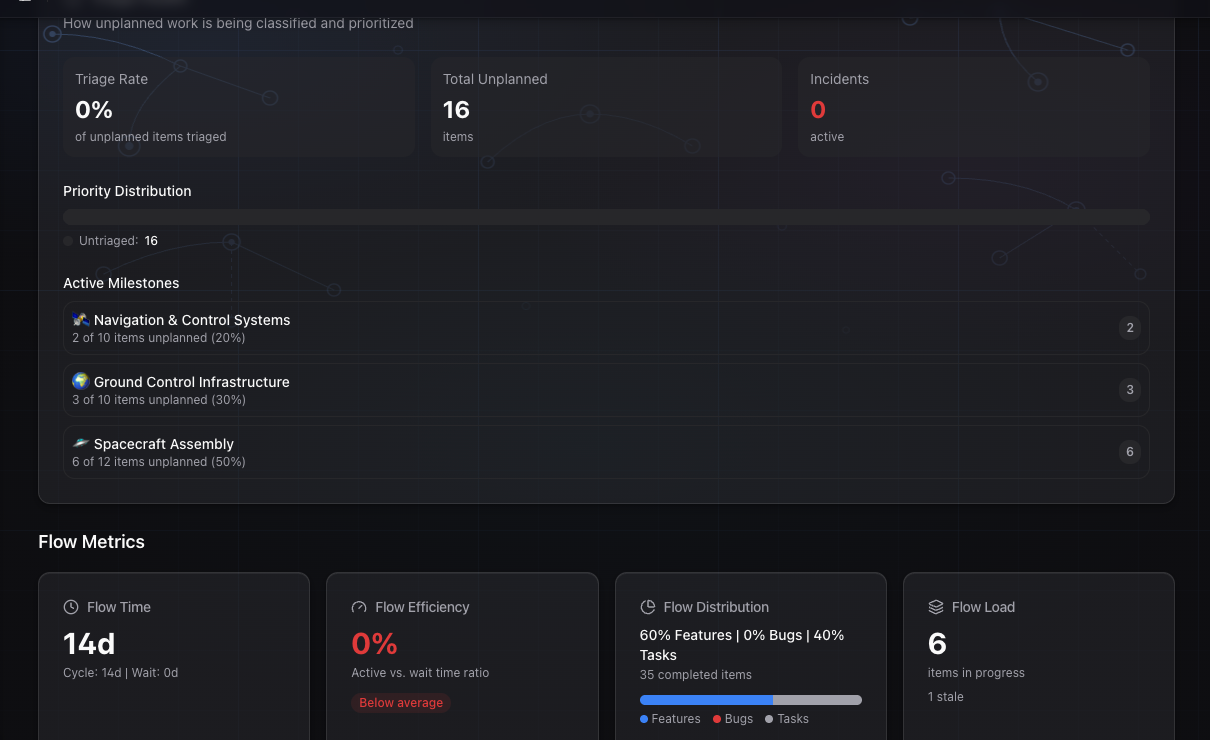
GoalPath detects unplanned work automatically through two distinct mechanisms.
The first is automatic scope detection. Any item added to a milestone that is already in progress gets flagged automatically. No manual tagging required. The moment someone adds a bug fix or a new task to a running milestone, GoalPath marks it as unplanned.
That flag shows up in a few places.
On the item itself: an orange "Unplanned" badge appears next to the status. Anyone opening the item can see immediately that this wasn't part of the original plan. The tooltip explains: "This item was added after the milestone started. It contributes to scope creep and may impact forecast accuracy."
The second mechanism is the triage inbox, a separate intake queue for work that arrives without a home. Items without an assigned milestone, or new requests that haven't been prioritized yet, land here. The inbox is GoalPath's structured alternative to ad-hoc Slack conversations. Each item can be assigned a triage priority: Incident (drop everything), Expedite (next in queue), Standard (work it in normally), or Deferred (acknowledge it, park it for later).
These are distinct mechanisms: the automatic scope detection tracks items added after a milestone started, while the triage inbox handles the intake flow before items are placed anywhere. Together, they give unplanned requests a visible home and a deliberate process, rather than a hallway conversation that only a few people heard.
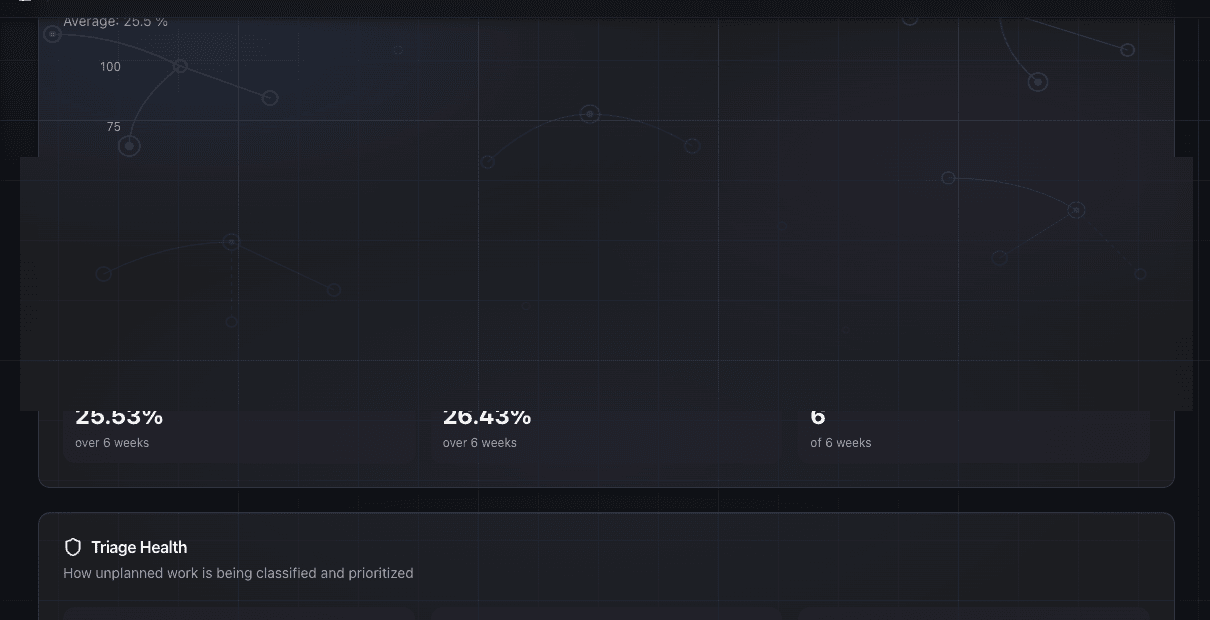
In the velocity analytics: GoalPath tracks your unplanned work ratio week by week across the project. Not just this sprint, but the trend over 12 weeks. You can see whether your ratio is creeping up, stabilizing, or improving. You can filter by team to see if the interruptions are distributed evenly or hitting one team harder.
The velocity chart itself shows the split visually. Orange bars are planned work, blue bars are unplanned. When the blue starts growing relative to the orange, you can see the interruption pattern forming before it shows up in a missed forecast.
The flow distribution view tells a different story
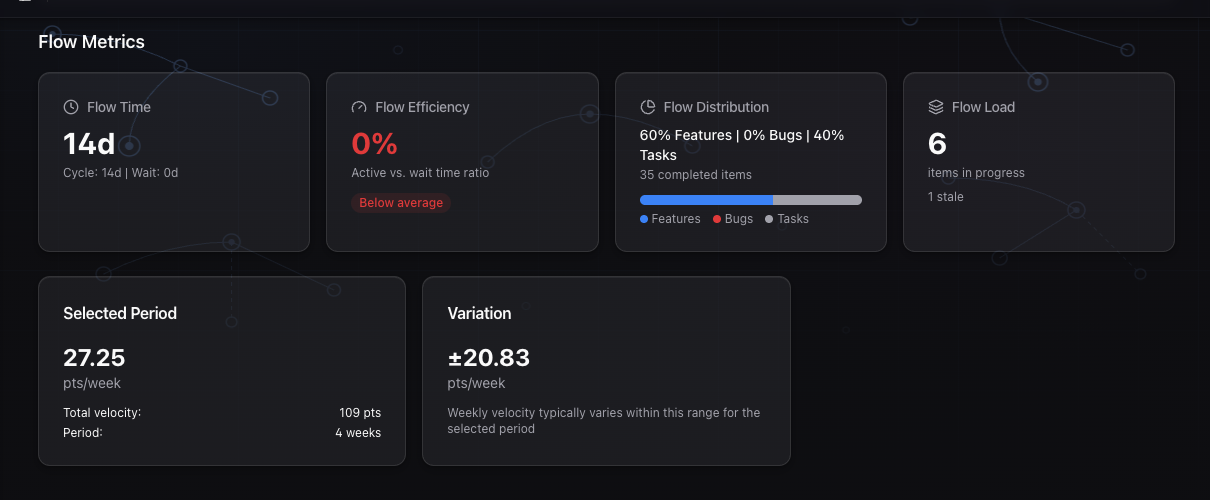
There's another angle that's easy to miss. The flow distribution chart in GoalPath's insights view shows your completed work broken down by type: Features, Bugs, and Tasks, tracked week by week.
If your bugs column is quietly growing, that's often a sign of reactive work accumulating. Features require planning. Bugs arrive. A healthy product team in a growth phase should be heavy on features. A team maintaining a legacy system might legitimately run 50% bugs. But if you're supposed to be building a new product and your distribution is quietly shifting to 60% bugs and 40% features, that's the data telling you something about where the interruptions are actually coming from.
Flow distribution doesn't just show what you shipped. It shows whether the thing you're building matches the thing you planned to build.
How forecasts absorb the data
The unplanned work data feeds directly into delivery forecasts, not just dashboards. GoalPath uses your historical unplanned work ratio to automatically adjust delivery forecasts.
If your last ten completed milestones averaged 20% unplanned work, GoalPath applies a 1.2x multiplier to future duration estimates. That 10-week milestone is probably a 12-week milestone when you account for the interruptions that will arrive. The adjustment is weighted toward recent milestones, so if your team has been getting better at triage, the forecast improves accordingly.
You're not just looking at the number after the fact. The number feeds forward into the forecast so stakeholders see realistic timelines, not optimistic ones.
Most teams don't have this. They have a sprint board and a gut feeling. GoalPath has the data from your last ten milestones, weighted by recency, baked into the next delivery estimate.
A simple way to read your own ratio
If you start tracking unplanned work today, here's a rough frame for what you're seeing. These are rules of thumb, not benchmarks from a study. Treat them as a starting point for your own calibration.
Under 15% is generally healthy. Some responsiveness is normal and good. Your planned work is mostly protected.
15–30% is worth watching. You're not in crisis, but unplanned work is taking a meaningful bite out of capacity. Worth a conversation about whether the triage process is working correctly. Are expedites being over-used? Are incidents being handled with the right level of urgency?
Above 30% consistently means the planning is probably not trustworthy. Stakeholders sense this even if they can't name it, which is often why they start asking "where are we?" multiple times a week. The forecast they were given doesn't match what they're observing. The fix isn't better planning. It's tightening the intake process, being more deliberate about what gets expedited, and surfacing the ratio explicitly in alignment meetings.
GoalPath's alignment meeting flow includes a flow health stage that surfaces active blockers, WIP limit warnings, unresolved escalations, and at-risk or stale milestones. These are the things most likely to derail the plan before the team even touches new priorities. The unplanned work ratio and flow distribution live on the Velocity Analytics page, and the alignment meeting is a natural moment to bring that data into the room before any new priorities are set. That conversation used to happen informally, in different places, with different people having different information. The alignment meeting makes it a standing ritual with the actual numbers in front of everyone.
The question the ratio answers
The question teams always struggle with is: are we slow, or were we just interrupted a lot?
Without the data, you can't answer it. The standup after a rough sprint usually produces a mix of vague explanations and defensive justifications. Everyone knows things went sideways. Nobody can say why with any precision.
With the unplanned work ratio, you can answer it in one number. If the ratio was 35% this sprint, the team wasn't slow. A third of their capacity was consumed by work that arrived after the plan was set. That's a different conversation than "we underestimated" or "people weren't focused."
It also tells you what to work on. If the ratio is high because of bugs, you have a quality problem. If it's high because of customer escalations, you have an expectation management problem. If it's high because stakeholders keep adding things mid-sprint, you have a prioritization governance problem.
The number points at the root cause. From there, you can actually fix something.
Further reading
- 2024 DORA State of DevOps Report: burnout research and organizational stability findings
- Accelerate State of DevOps 2022: unplanned work benchmarks and interrupt-driven work patterns
Ready to plan your roadmap with data?
Create an account on GoalPath and start tracking velocity, forecasting milestones, and delivering predictably.
Create an Account