What makes delivery predictable (and what breaks it)
The question nobody wants to answer
Someone asks when the milestone will ship. You have a feeling. You have a spreadsheet. You have last sprint's velocity and a rough point count. You do the math in your head, add a mental buffer because things always take longer, and give a date.
Three weeks later the date is wrong.
Not wrong because your team stopped working. Wrong because the math was always hiding something, and now that something showed up as an unplanned incident, a scope addition, a dependent milestone that wasn't as done as it looked, or just natural velocity variance that hit in the wrong direction.
Some teams are good at this. They give dates and they land within a week of them, consistently. Most teams are not. The question is what separates them.
What actually drives predictability
There are four signals that show up repeatedly in teams that forecast reliably. None of them are surprising in isolation. What's surprising is how rarely teams measure all four at once.
Consistent velocity. Not high velocity. Consistent. A team that delivers 9-11 points every week is much easier to forecast than one that delivers 5 one week and 18 the next. DORA research and flow framework literature both point to stability as a stronger predictor of on-time delivery than raw throughput. When velocity swings wildly, any forecast built on the average is likely to miss. The question to ask is not "what's our average velocity?" but "what's the variance around that average?" High variance is the forecast killer.
Low WIP variance. Teams that limit work in progress tightly have two advantages. First, individual items move faster because there's less multitasking tax. Second, and more relevant to forecasting, the number of items in flight stays predictable. When WIP is high and variable, you get unpredictable queue buildup. Little's Law makes this precise: lead time equals WIP divided by throughput. Double the WIP without increasing throughput and you've doubled your lead time. Limit WIP and lead time stabilizes. Stabilize lead time and forecasting gets dramatically easier.
Estimated backlogs. This one sounds obvious. It's not. Many teams estimate the items they're about to start and leave the rest rough. That works for sprint planning but it destroys milestone-level forecasting. If 40% of your milestone's items are unestimated, any forecast of the whole milestone has a giant unknown built into it. The forecast might look precise, but it isn't. The confidence interval should be wide enough to drive a truck through.
Fewer parallel tracks. Context switching degrades velocity in a fairly well-documented way. When team members split attention across multiple active milestones, each track moves slower than it would if the team was focused. This compounds the forecasting problem: more parallel tracks means more variance in which track gets attention in any given week, which means more variance in individual milestone progress, which means wider forecast ranges for everything.
These four signals are connected. Teams that limit WIP naturally have fewer parallel tracks. Teams with estimated backlogs can catch unestimated items before they become forecast surprises. Teams with consistent velocity have usually already solved the WIP and parallel work problems that cause variance.
The ritual that produces false confidence
When someone asks "when will this ship?" the typical answer is the spreadsheet forecast. A PM, tech lead, or founder opens a Google Sheet or a Jira report, looks at remaining work, estimates it roughly, divides by something like average velocity, adds a buffer, and sends a date. This takes maybe ten minutes and produces a number that looks precise.
The problem isn't the ten minutes. The problem is that this answer doesn't surface what it doesn't know.
It doesn't account for velocity variance. If your team's weekly output swings by ±40%, a point-estimate forecast will be wrong. It doesn't account for unestimated items, which add invisible mass to the milestone. It doesn't account for parallel work stealing capacity. And it doesn't propagate uncertainty through dependencies: if this milestone depends on another one that's also being estimated the same way, the error compounds.
A single date with no confidence interval is worse than no forecast at all, because it creates false confidence. Stakeholders anchor to it. The PM feels committed to it. And then reality diverges from the spreadsheet.
How GoalPath reads these signals automatically
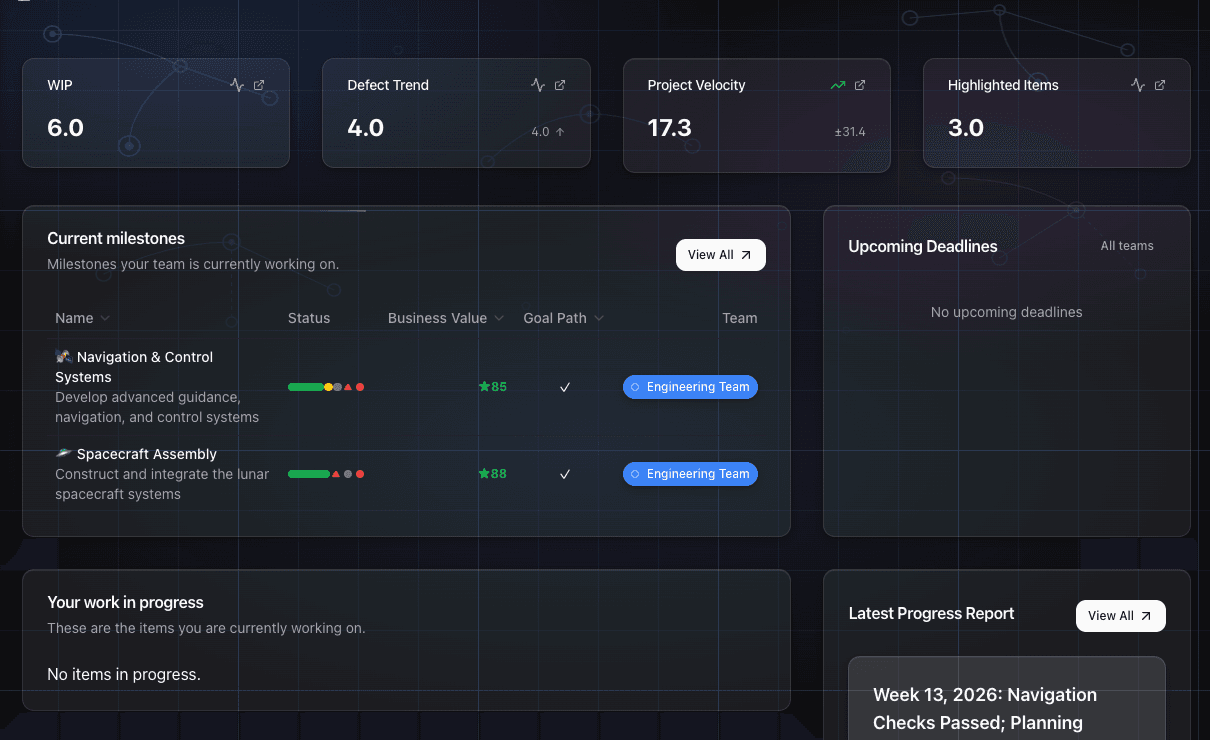
GoalPath tracks all four predictability signals continuously, so you're not doing the Friday afternoon calculation from memory.
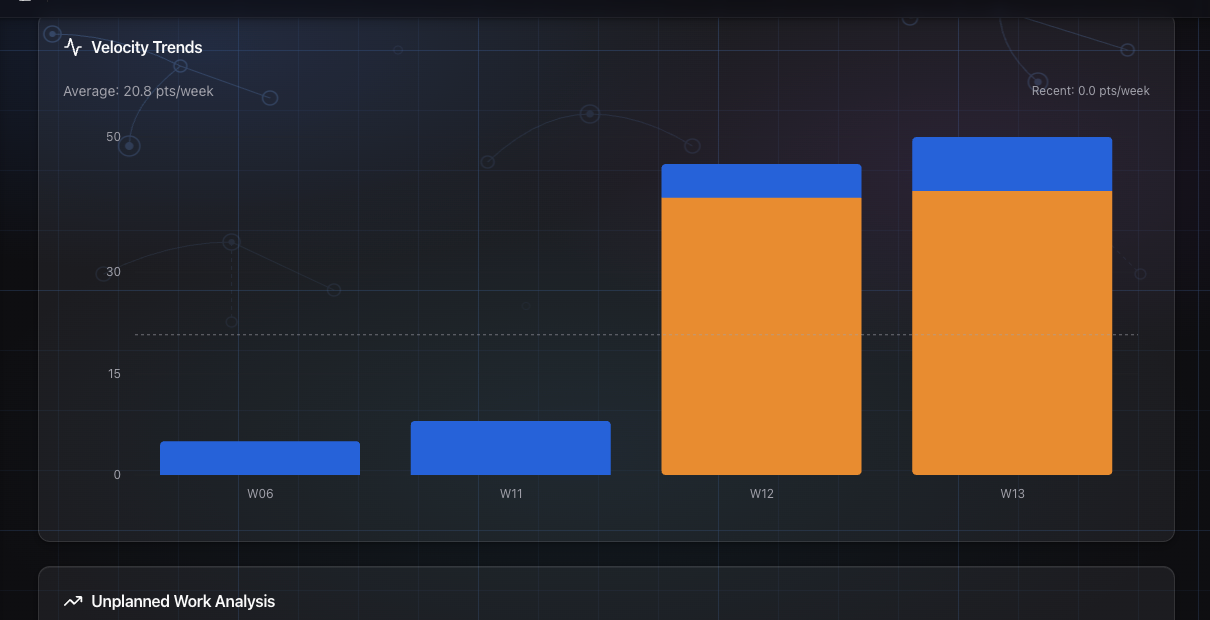
Velocity trend analysis. The velocity page shows weekly throughput over the rolling six-week window, with standard deviation surfaced alongside the average. You can see immediately whether your team is stable or swinging. A tight cluster of weekly bars means high-confidence forecasts. A scattered one means wide ranges are warranted.
Three-point forecasting. Every milestone forecast shows three numbers, not one: optimistic, most likely, and pessimistic completion dates. These aren't guesses. They're derived from actual velocity variance using a straightforward calculation: mean velocity plus or minus one standard deviation. It's not a Monte Carlo simulation. It's a direct translation of how consistently your team has delivered. A team that's delivered 9-11 points per week for six weeks gets a tighter range than a team that swings 5 to 18. The range is earned by consistency, or widened by variance.
Confidence levels. Each forecast carries an explicit confidence level (high, medium, or low), and what you get depends on both velocity consistency and how the forecast is calculated. Teams with their own dedicated velocity data and low variance (standard deviation below 50% of average velocity) get High confidence. Projects where GoalPath falls back to global or cross-team velocity data get Medium or Low depending on variance. When there isn't enough data at all (for example, a new team that hasn't yet built a velocity history), GoalPath falls back to historical averages or industry defaults, and the forecast will say so. Don't expect tight ranges from day one; the forecast gets more accurate as your delivery data accumulates. When you're looking at a forecast and it says "Low confidence," that's the system telling you the three-point range is real and wide. GoalPath surfaces this rather than hiding it.
Uncertainty propagation through dependencies. This is the part that catches most teams off guard. GoalPath schedules milestones sequentially within each team, ordered by priority. If earlier milestones have wide forecast ranges, later milestones inherit that uncertainty. A milestone can't start until the ones ahead of it finish. GoalPath shows the expected start date for a milestone including the cumulative slip potential of its predecessors. If the milestones before this one have wide confidence ranges, the start date range for this milestone reflects that honestly.
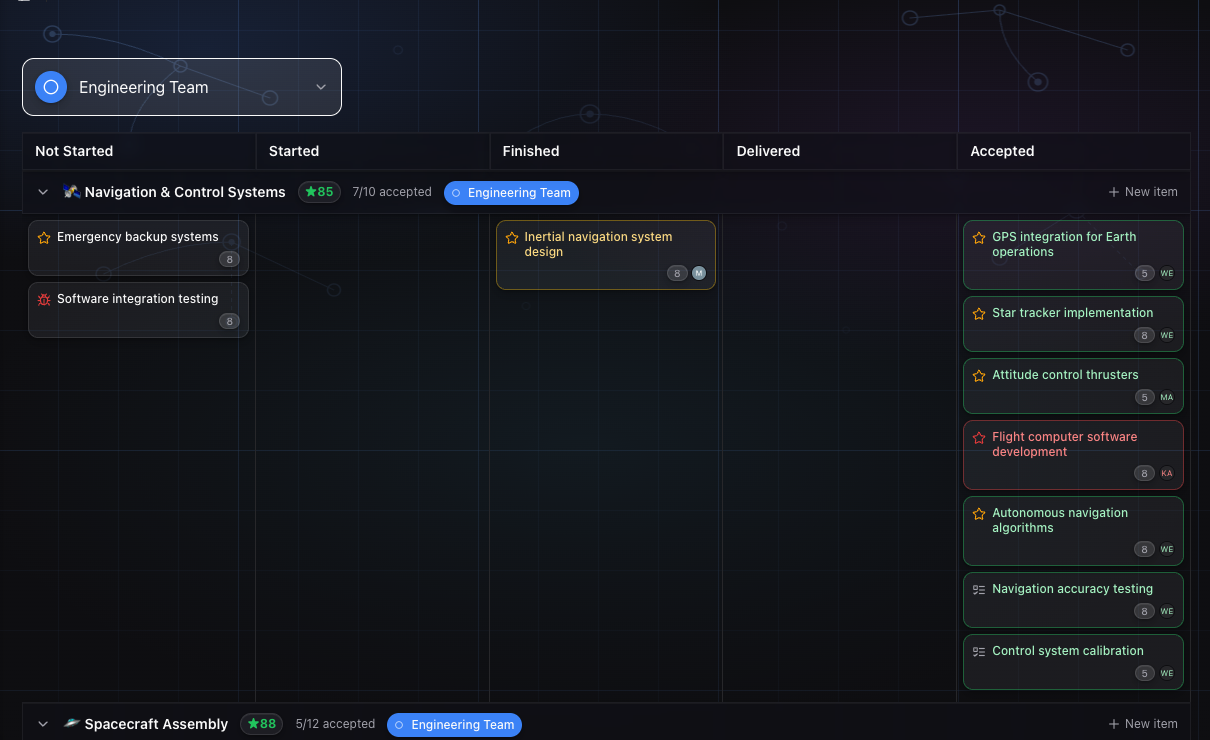
Unestimated item warnings. When items in a milestone haven't been estimated, GoalPath surfaces the count in the forecast panel with an explicit note that accuracy is reduced. This turns an invisible problem into a visible one. The fix is simple: estimate those items. But until you do, you see the forecast for what it is: partially informed.
Multitasking penalties. When your team is actively working across multiple milestones simultaneously, GoalPath applies a velocity reduction to each. Running two to three concurrent milestones applies a 15% capacity penalty. Running four to seven applies 30%. Running eight or more applies 50%. These tiers are based on the documented cost of context switching on effective throughput. There's also a separate velocity-division effect: team velocity is split across the number of milestones currently in progress, so each active track is effectively working with a fraction of total team capacity. The forecast you see already accounts for both of these parallel-work costs.
What changes when you look at this regularly
The forecast panel in GoalPath isn't just for when a stakeholder asks "when will this ship?" It's meant to be a regular part of planning and prioritization.
When you open a milestone and see a low confidence forecast with a three-week spread between optimistic and pessimistic, that's a signal to do something: estimate the unestimated items, split parallel tracks, address velocity instability. The forecast shows you the problem before it becomes a missed date.
When the forecast shifts (say, optimistic slips by a week after new items get added to the milestone), the change in the forecast is itself informative. GoalPath's progress reports include forecast deltas: "this milestone moved from May 12 to May 19 this week." That's the kind of early signal that lets stakeholders recalibrate before the date becomes a crisis.
This replaces the "where are we?" ping. Not because GoalPath automatically sends that email for you (though it does generate the weekly progress report draft), but because when stakeholders have a live, calibrated forecast instead of a stale spreadsheet date, the question answers itself.
The confidence you can give stakeholders
What separates teams that forecast reliably from those that don't is the quality of the underlying execution data, not the sophistication of their tools.
Teams that can say "we'll ship between April 28 and May 14, with the most likely date around May 5, at medium confidence" are giving stakeholders something real. Teams that say "probably mid-May" are guessing out loud. Both are estimates, but one has math behind it and the other has vibes.
GoalPath's forecast engine is built on six weeks of actual delivery data, standard deviation of your real velocity, explicit accounting for unestimated scope, multitasking cost, and dependency uncertainty. The forecast is as good as your execution data, and it tells you what would make it better.
That's the point. Not a better spreadsheet. A system that shows you the signals that drive predictability, in real time, so you can act on them before they become missed dates.
Further reading
- DORA metrics and software delivery performance: the research foundation for measuring delivery performance
- Little's Law and WIP limits: the math behind why WIP reduction improves lead time predictability (search for "Little's Law Kanban" for many solid explanations)
- Objectively measuring predictability: ASOS Engineering on how they quantify forecast accuracy
- Delivery metrics to improve predictability: Plandek on the metrics that signal whether predictability is improving
Ready to plan your roadmap with data?
Create an account on GoalPath and start tracking velocity, forecasting milestones, and delivering predictably.
Create an Account