The SPACE Framework: Beyond Throughput
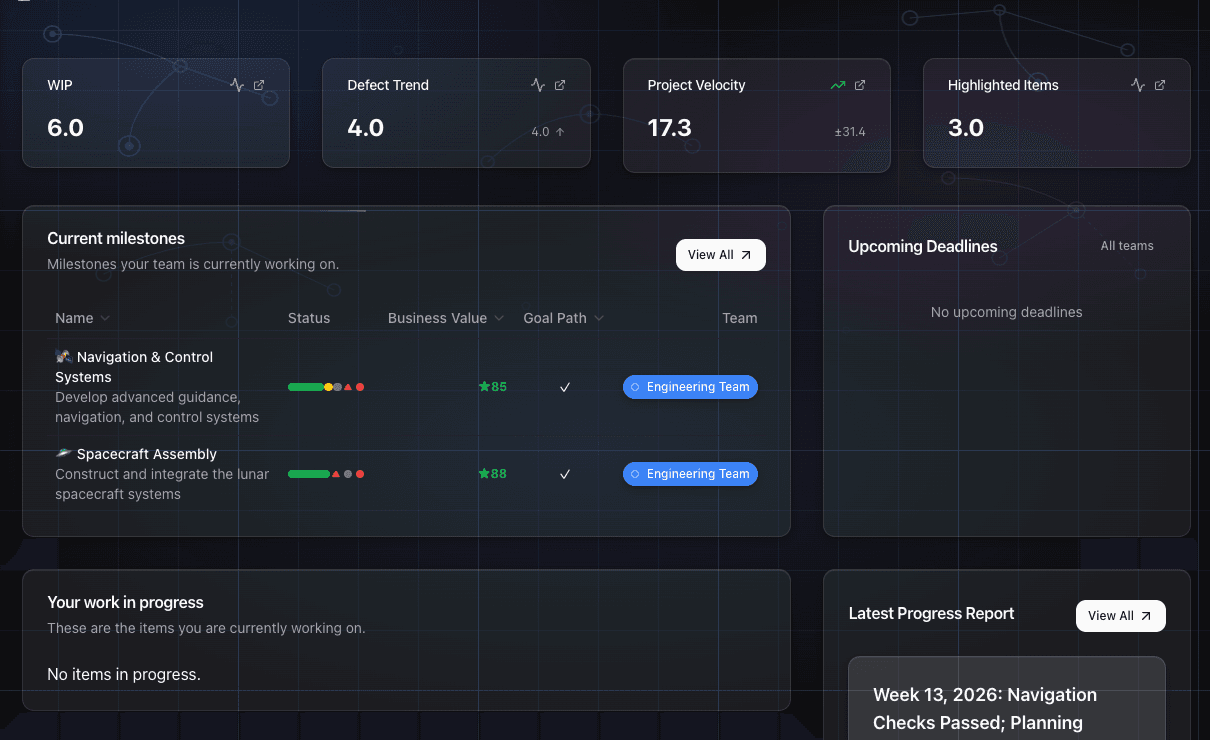
Throughput is not the whole story
Most teams, when asked how productive they are, point to velocity. Points per sprint. PRs merged per week. Story points delivered against the roadmap.
It is not a bad instinct. Those numbers are real. But if you have ever managed a team that was hitting velocity targets and still missing every forecast, or watched a team slow down right before they burned out, you know that throughput alone is a bad summary of what is happening.
In 2021, a group of researchers from Microsoft, GitHub, and the University of Victoria published a paper in ACM Queue called "The SPACE of Developer Productivity." Their core finding was simple: productivity cannot be reduced to a single dimension. They proposed five.
SPACE stands for Satisfaction, Performance, Activity, Collaboration and culture, and Efficiency. No single metric covers more than one of those dimensions. Which means if you are only tracking one thing, you are flying with four instruments missing.
The five dimensions, in plain terms
Satisfaction is whether developers find the work meaningful, whether they feel the tools and process support them, and whether the job is sustainable. It shows up as retention, engagement, and the quality of work people are willing to put in when things get hard.
Performance is outcomes, not outputs. Did the features shipped actually achieve what they were meant to achieve? For a delivery team, it shows up as velocity, forecast accuracy, and change failure rate.
Activity is the volume of work happening. Commits, PRs, items in progress, tasks completed. Activity is easy to measure and easy to misread. High activity alongside low performance usually means something is broken in the flow.
Collaboration and culture is how well information moves across the team, and whether the environment supports people doing their best work. Are blockers surfaced quickly? Do people know what others are working on? Is the team aligned on priorities? This one is almost impossible to measure with tooling alone.
Efficiency is how smoothly work moves from start to done. Cycle time, flow efficiency, the ratio of active work time to total lead time. A team with poor efficiency is one where work starts and then sits, waiting for review, waiting for a decision, waiting for a dependency to resolve.
The paper's recommendation is to measure across at least three dimensions to get a meaningful picture. One or two dimensions creates blind spots you will not see until they become expensive.
Which three GoalPath covers automatically
GoalPath does not cover all five. It is worth being honest about that.
Satisfaction requires asking people. No amount of workflow data tells you whether someone feels burned out or undervalued. That needs a survey, a one-on-one, a manager who is paying attention.
Collaboration and culture, in the sense the SPACE framework means it, is also hard to instrument. You can proxy it, but the real signal comes from observing how the team actually coordinates, what gets missed, where misalignment shows up after the fact.
What GoalPath does cover, and covers without any extra work from the team, is Performance, Activity, and Efficiency.
Performance: velocity and forecasts
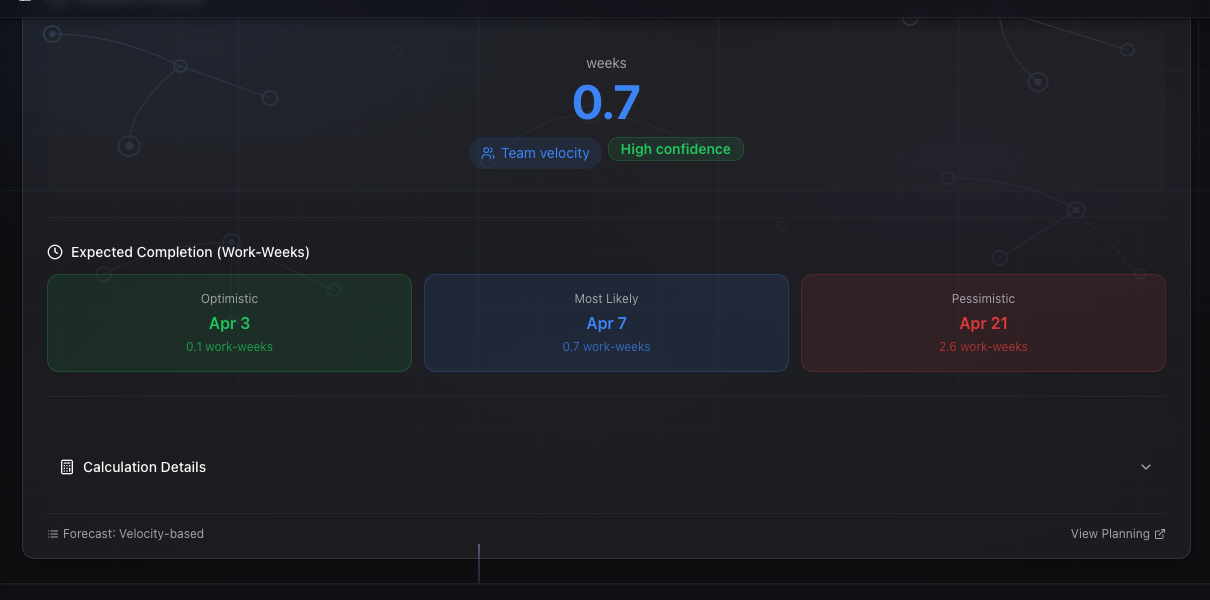
Every time a team marks work finished in GoalPath, the system updates its velocity model. Velocity is calculated across the last six weeks. Consistency matters as much as speed. A team that delivers 10 points every week is more predictable than one that swings between 5 and 20, and GoalPath tracks that variance and uses it to widen or narrow the forecast range accordingly.
The forecast tells you the expected completion window for each milestone, updated continuously as work comes in or slips. This replaces the "where are we?" sync, the Friday status email, and the quarterly guess-and-spreadsheet exercise that most teams still run.
Activity: WIP and flow load
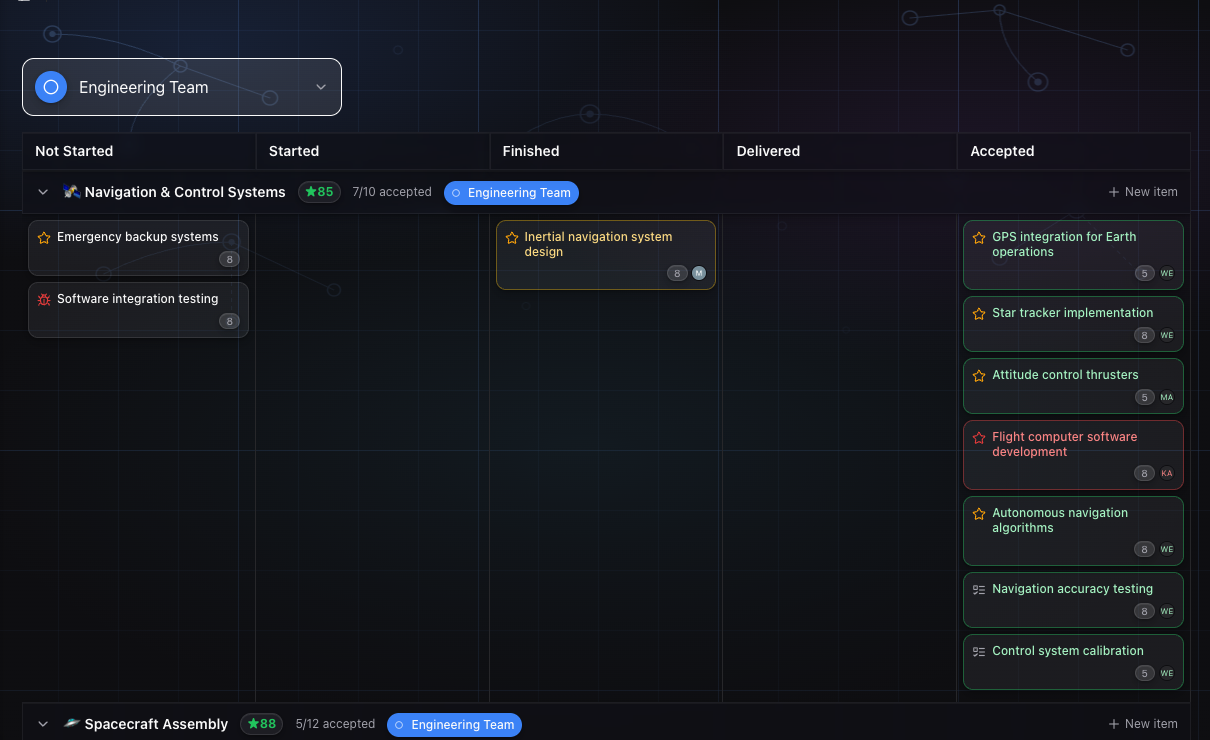
GoalPath tracks how many items are in flight across the team at any point, and how that load is distributed across milestones. GoalPath calculates a penalty for each team member based on how many milestones they are personally juggling, not as a punishment, but because the research is clear that context switching reduces effective throughput. The original SPACE paper notes that high activity can actually be a warning sign: more volume sometimes means brute-forcing through bad systems, not genuine capacity.
The WIP view in GoalPath makes this visible. You can see instantly whether the team is focused or scattered. Items sitting in "Started" without movement flag early, before they become a stakeholder conversation about why the milestone is late.
Efficiency: flow efficiency and cycle time
Flow efficiency is the ratio of active work time to total lead time. Most teams sit at 15–25%, meaning three quarters of the time from "work started" to "work done" is waiting, not working. Reviews queued up, decisions pending, dependencies unresolved.
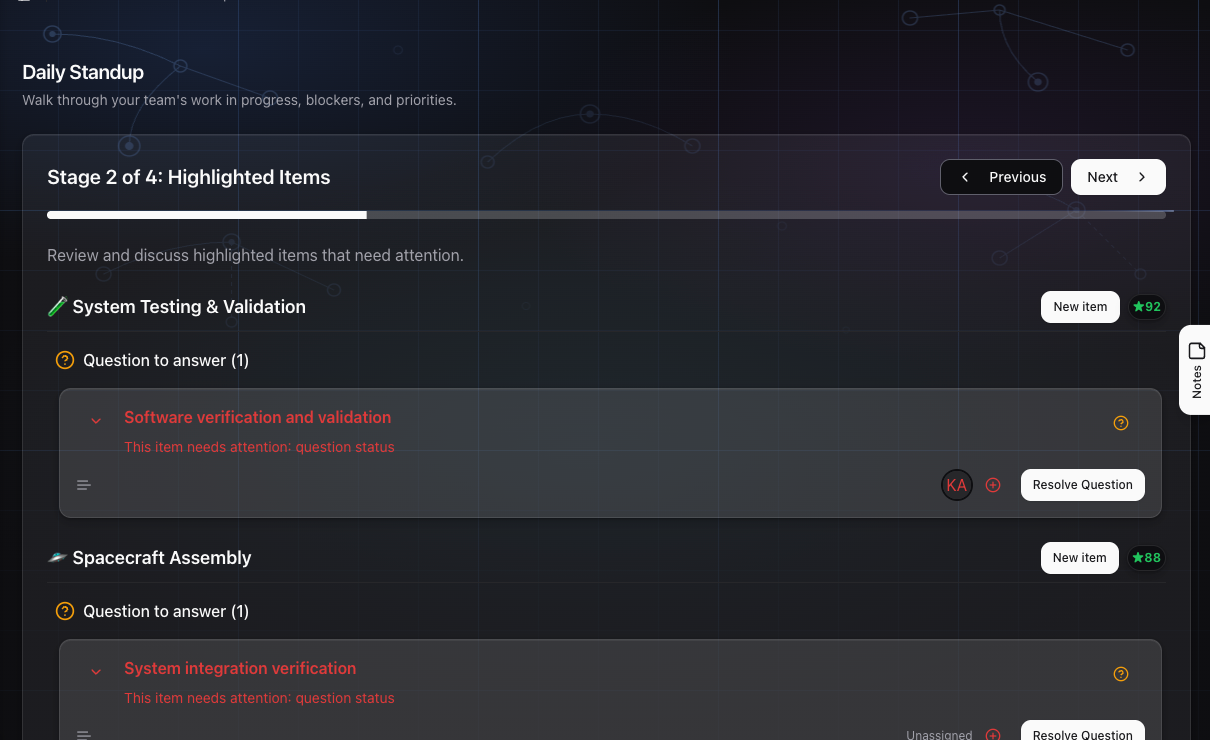
GoalPath tracks cycle time for every item, from when work starts to when it finishes, and surfaces items that are aging in place. This is where the efficiency dimension of SPACE becomes actionable. It is not that the team is slow. It is that something is blocking flow, and the data shows you where.
The replaced ritual
The monthly productivity review. Every engineering organization runs some version of it. Someone pulls together a spreadsheet of commits, PRs, or story points, and the conversation becomes "are we going fast enough?" It is the wrong question, and the data never tells you why the number is what it is.
The SPACE framework reframes the question to: fast and sustainable, or fast and fragile? The three dimensions GoalPath surfaces automatically give you enough of that picture to have a real conversation. Velocity tells you the pace. WIP tells you whether the pace is sustainable. Cycle time tells you where the friction is.
The mechanism is straightforward: GoalPath's guided workflow captures structured execution data as teams work, and that data becomes the report. No one fills in a status update. No one aggregates a spreadsheet. The progress report, the forecast, and the efficiency view are all outputs of the same workflow that was already happening.
What you still need to do yourself
The two dimensions GoalPath cannot measure for you are the two that require conversation.
Satisfaction shows up in attrition and in the quality of work before it shows up in any dashboard. The best signal is a regular one-on-one where you ask how it actually feels to be on the team right now. Not "are you blocked?" but "is the work sustainable? Do you feel like what you're building matters?"
Collaboration and culture shows up in the quality of handoffs and in how quickly the team surfaces misalignment. The best proxy is whether blockers are raised early or raised after they have already slipped a milestone. If your team tends to surface problems late, that is a collaboration signal, not a velocity one.
These two dimensions require you to show up as a manager, not just as someone who reads dashboards.
A more complete picture
The SPACE framework is not a checklist to fill out. It is a reminder that any single number you use to describe team productivity is, at best, a rough approximation.
GoalPath covers three of the five dimensions automatically, from the same workflow data the team is generating anyway. For the other two, there is no substitute for asking.
That is a more honest way to think about productivity than velocity alone ever was.
Further reading
- The SPACE of Developer Productivity (ACM Queue, 2021): the original paper by Forsgren et al., free to read
- What is the SPACE framework and when should you use it? (GetDX): practical breakdown of which metrics fit each dimension
- DORA 2025 Report: how AI tools are changing throughput metrics while leaving delivery stability flat
- Activity ≠ progress: how WIP overload makes teams look productive while delivery stalls
Ready to plan your roadmap with data?
Create an account on GoalPath and start tracking velocity, forecasting milestones, and delivering predictably.
Create an Account