GoalPath vs Asana
Asana is a polished, general-purpose work management platform built for any team — marketing, ops, HR, and engineering. Excellent for cross-functional coordination. Software teams often find themselves hacking together sprint workflows and delivery tracking in a tool never designed for them.
TL;DR — 3 key differences
- 1.GoalPath is purpose-built for software teams with sprints and velocity — Asana is a general work management tool with no dev workflow
- 2.GoalPath forecasts delivery dates with Monte Carlo simulations — Asana has no data-driven forecasting
- 3.GoalPath generates weekly progress reports automatically — Asana requires manual status updates
GoalPath in action
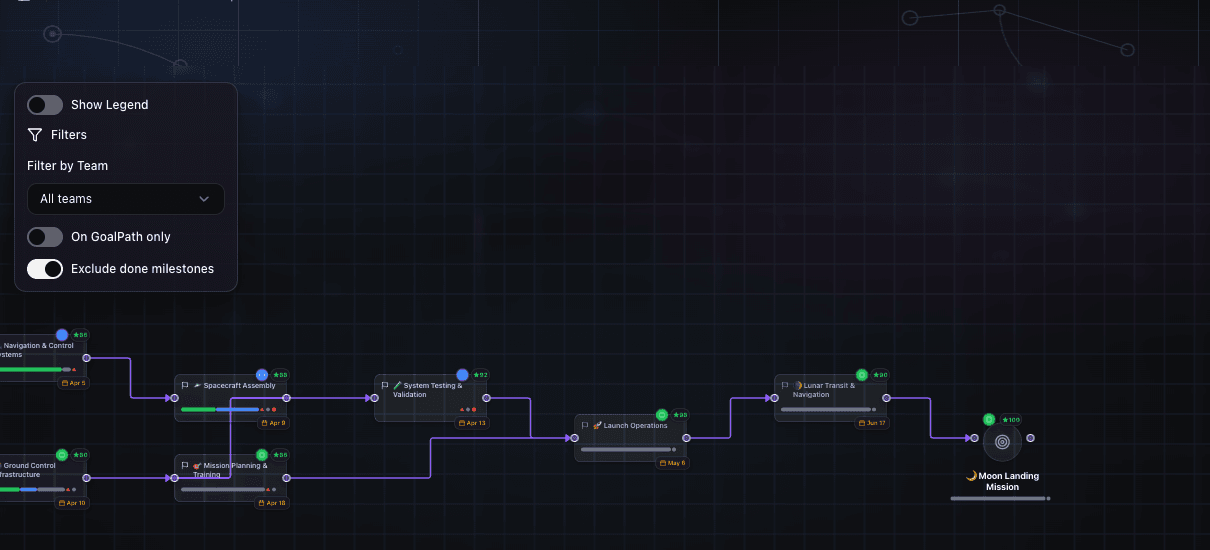
Visual roadmap with milestone dependencies and goal path connections
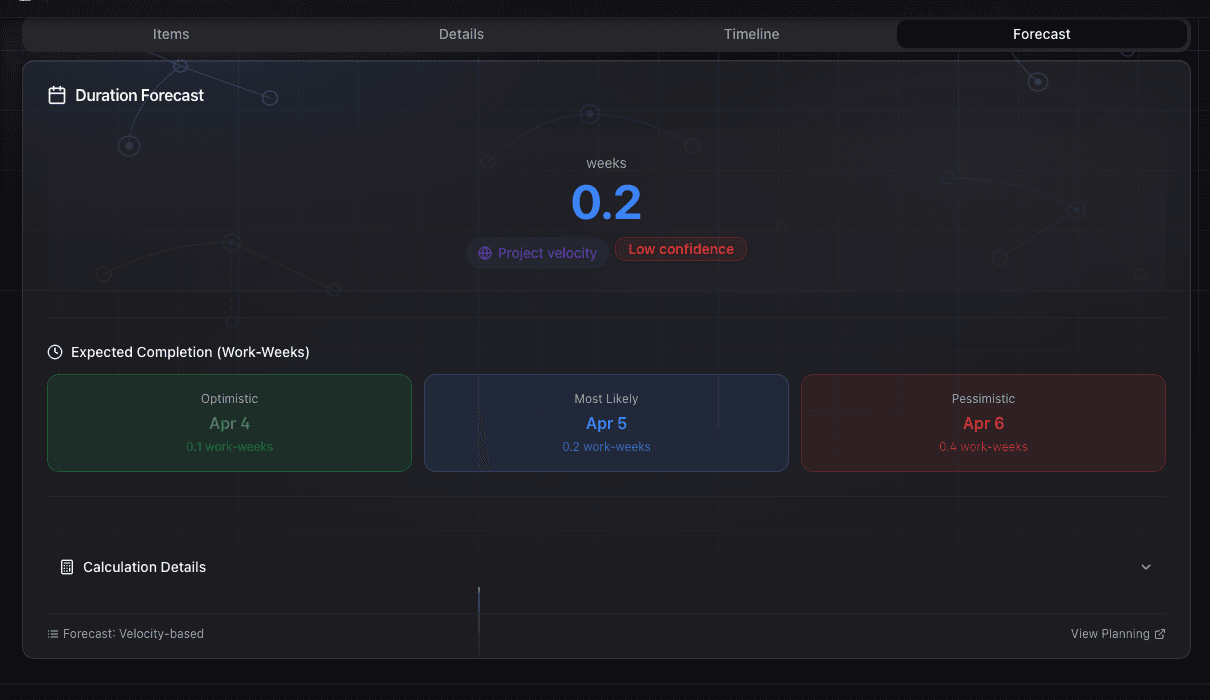
Monte Carlo delivery forecasting — optimistic, expected, and pessimistic dates
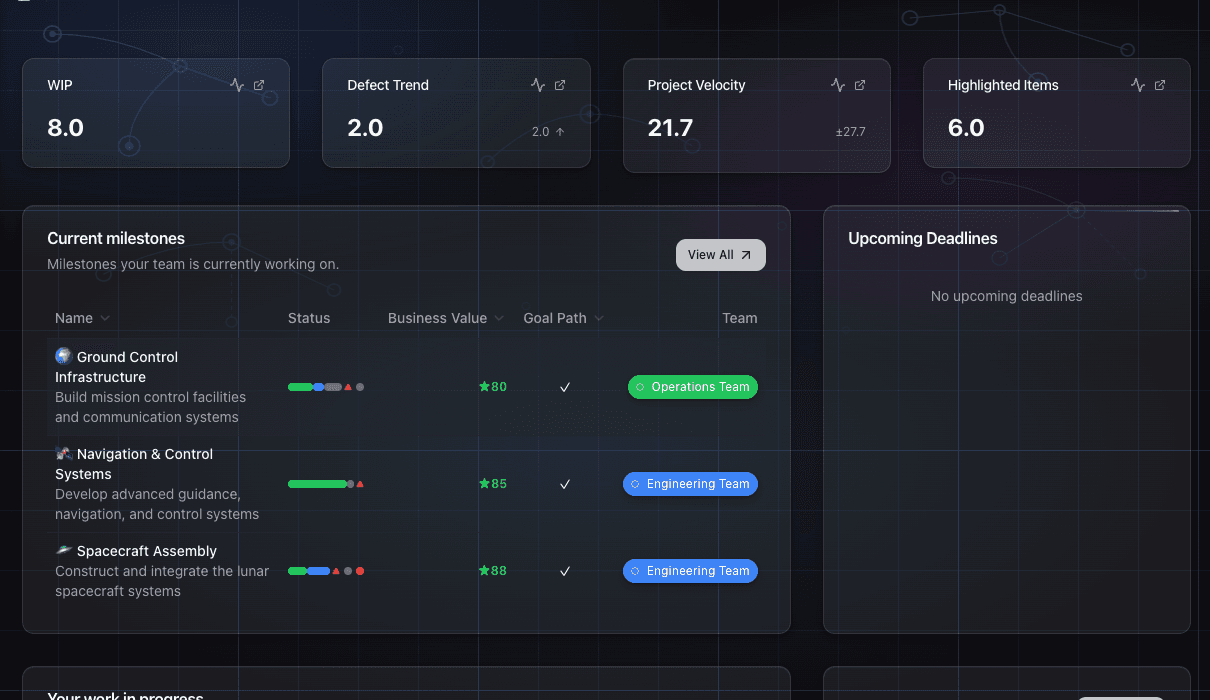
Dashboard with at-a-glance metrics — WIP, velocity, defects, and highlights
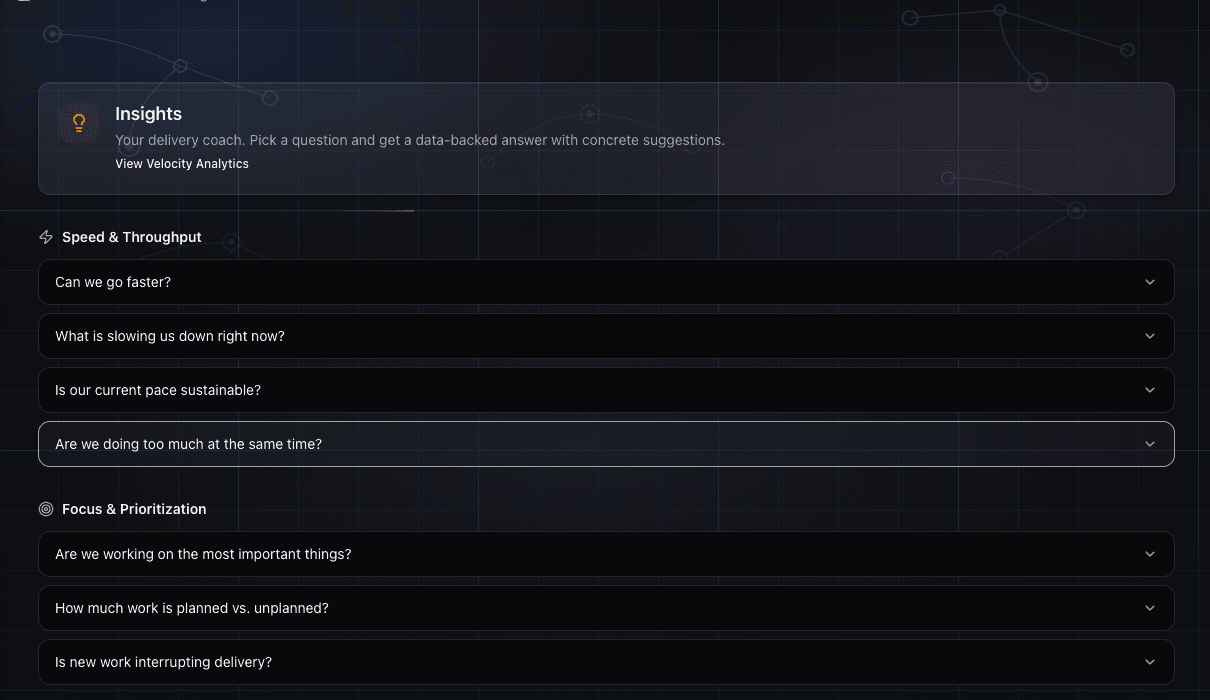
AI-powered delivery insights — ask questions, get data-backed answers
At a glance
| Attribute | GoalPath | Asana |
|---|---|---|
| Best for | Engineering teams shipping software milestones | Cross-functional teams spanning marketing, operations, and engineering |
| Free trial | ✓30 days, no credit card | Free for up to 10 users |
| Delivery forecasting | ✓Monte Carlo with probability bands | Manual or add-on only |
| Auto progress reports | ✓Weekly, AI-generated | ✕Manual only |
| Guided process | ✓Opinionated workflow | Fully customizable |
| Team size focus | 5–50 people | Organizations with 20–500 employees needing one tool for all departments |
Workflow & Process
| Feature | GoalPath | Asana | Winner |
|---|---|---|---|
| Guided workflow | Methodology built into the interface — triage, milestone, board, forecast | Blank canvas — teams define their own process in external wikis | GoalPath wins |
| Triage system | Structured inbox triage with guided priority and milestone assignment | No triage concept — unplanned work lands directly in projects | GoalPath wins |
| Cross-functional use | Purpose-built for software delivery teams | Works for any team — marketing, HR, finance, and engineering | Competitor wins |
Reporting & Communication
| Feature | GoalPath | Asana | Winner |
|---|---|---|---|
| Progress reports | Automatic reports generated as a byproduct of team's normal workflow | AI status summaries exist but require manual triggers and lack forecast data | GoalPath wins |
| OKR / Goals alignment | Milestone-based delivery tracking focused on shipping | Goals feature links tasks to company OKRs, visible to executives | Competitor wins |
Forecasting
| Feature | GoalPath | Asana | Winner |
|---|---|---|---|
| Delivery forecasting | Monte Carlo simulation from actual team throughput — updates automatically | No probabilistic forecasting — delivery dates are manually set estimates | GoalPath wins |
Integration & Ecosystem
| Feature | GoalPath | Asana | Winner |
|---|---|---|---|
| Integration breadth | REST API, MCP server, browser extension (Chrome/Firefox/Edge), and VS Code extension | 454 marketplace apps, 200+ native integrations, Zapier access to 7,000+ tools | Competitor wins |
| GitHub integration | Standard GitHub/GitLab integration | Basic — one PR per task limit, friction point for dev teams | Tie |
| Bug reporting from browser | Built-in browser extension captures screenshots, console errors, and page context in one click | No built-in bug reporting — manual screenshots and copy-pasting into tasks | GoalPath wins |
Asana: honest assessment
What Asana does well
- ✓Genuinely polished UX — non-technical users get up to speed quickly
- ✓Cross-project portfolios and Goals give executives real program visibility
- ✓454 marketplace apps and 200+ native integrations
- ✓Workflow Builder for no-code visual automations
- ✓AI-generated status summaries reduce some manual reporting burden
- ✓Publicly traded, enterprise-ready with SOC2 and HIPAA compliance options
- ✓OKR/Goals feature links team tasks to company-level objectives
Common complaints
- ✕Not built for software engineering — no sprint planning, velocity tracking, or burndown charts
- ✕No delivery forecasting — dates are whatever someone typed in a field
- ✕5-seat minimum on paid plans hidden until checkout
- ✕Goals and portfolios locked behind the $24.99 Advanced tier (2x price jump from Starter)
- ✕No built-in development process — teams define and document their own conventions
- ✕Nested subtasks beyond 2–3 levels become unwieldy
- ✕Without enforced methodology, Asana workspaces drift into chaos as teams scale
Should you switch?
Switch to GoalPath if you...
- →Software team spending hours hacking together a sprint workflow in a tool not built for it
- →Delivery dates are always someone's best guess — never based on actual throughput data
- →Engineering lead spending 3–5 hours per week writing status updates manually
- →New hires need weeks of onboarding to understand 'how we use Asana here'
- →Hitting the Starter ceiling but unwilling to pay 2x for Advanced
Stay with Asana if you...
- ·Cross-functional teams where marketing, legal, and finance actively use the same tool as engineers
- ·Company-wide OKR tracking that links every team's work to executive goals in one place
- ·Deep integration requirements with Salesforce, Tableau, or Adobe Creative Cloud
- ·Enterprise procurement requiring HIPAA compliance, data residency, or EKM
Ready to make the switch?
Start your free trial and see why teams leave Asana for GoalPath. No credit card required.
More comparisons
GoalPath vs Jira
Plan, track, and release great software
GoalPath vs Monday.com
A Work OS that lets you shape workflows, your way
GoalPath vs Linear
The issue tracker built for speed
GoalPath vs ClickUp
The everything app for work
GoalPath vs Shortcut
The project management platform engineering teams love
GoalPath vs ZenHub
Project management built for GitHub